WirelessImplants.com is available for strategic acquisition Enquire discreetly

VETERINARY · CONSERVATION · LIVESTOCK

Wireless identification and sensing across the animal world.

From companion-animal identity to aquatic telemetry and internal livestock sensing, small wireless devices already operate inside living systems beyond human medicine.

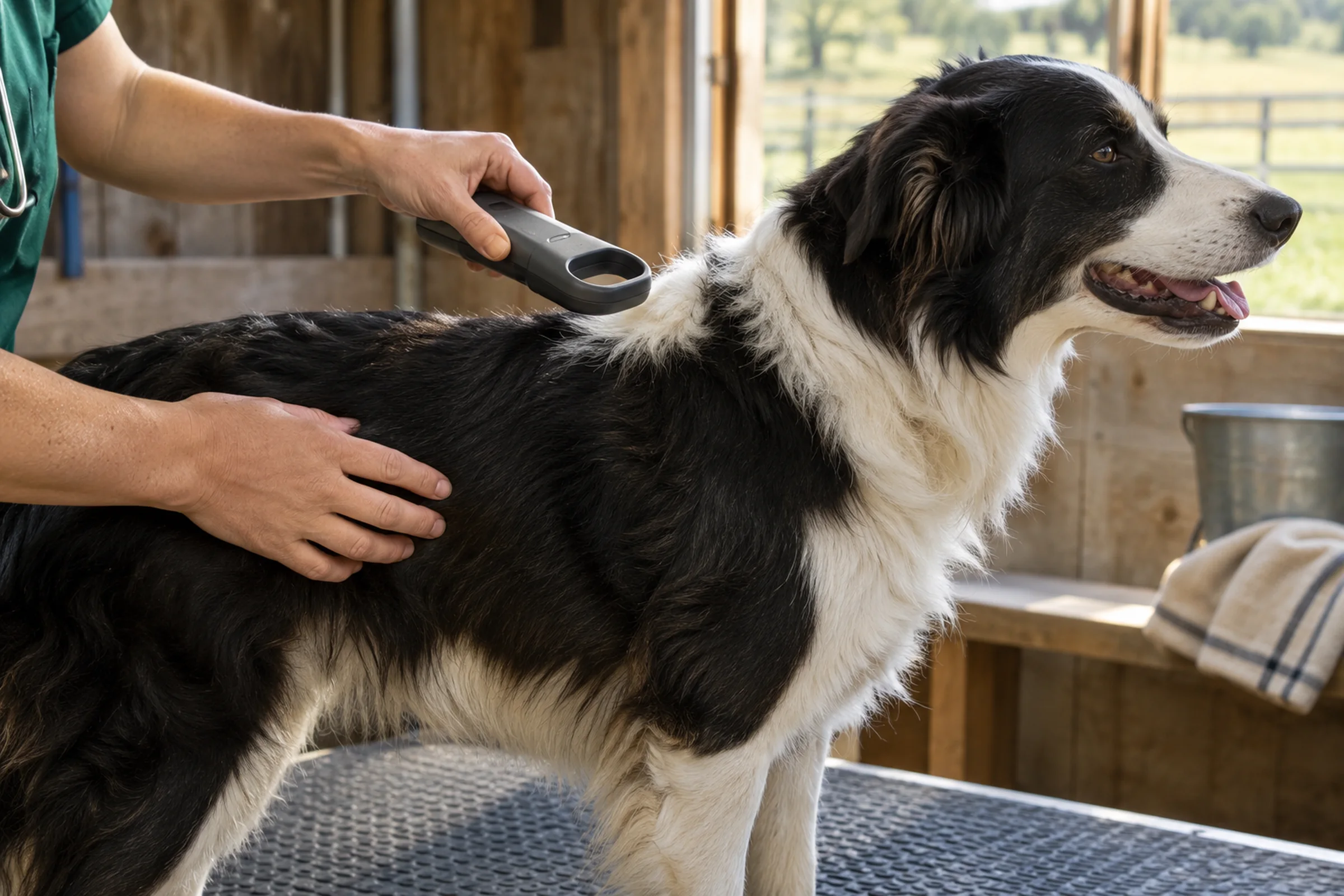
Veterinarian scanning a dog’s shoulder with a handheld RFID reader
Representative visualization — not a photograph of a commercial product.

ANIMAL IDENTIFICATION

Passive microchips, active readers.

Veterinary identification is one of the clearest established applications of an implanted wireless transponder.

COMPANION ANIMALS

Subcutaneous identification

Veterinary RFID microchips store a unique identifier in a small biocompatible transponder that a compatible scanner can interrogate. Passive identification does not require an implanted GPS receiver and ordinarily does not provide continuous location tracking.

Datamars passive microchip

RFID ARCHITECTURE

The reader is part of the system

Real-world usefulness depends on tag placement, identification standards, reader compatibility and registration records. The reader supplies the interrogation field for many passive transponder designs; the implanted device returns its encoded identity.

Transponder technical description

WILDLIFE TELEMETRY

Acoustic signals travel where radio struggles.

Underwater tracking provides a distinct wireless-implant use case with an established research equipment ecosystem.

FIELD RESEARCH

Surgically implanted aquatic transmitters

Acoustic fish tags can emit coded sound signals detected by underwater receiver arrays. Peer-reviewed field methods document internal implantation of acoustic transmitters for tracking fish movement, survival and behavior.

Published implantation study  ·  Aquatic tracking technology

CONSERVATION SCIENCE

From tag to receiver network

A small transmitter, an array of stationary or mobile hydrophones, synchronized detections and ecological analysis form one complete monitoring architecture. Design depends on species, handling, tag burden, battery life, detection conditions and study duration.

Receiver and transmitter systems
PRECISION LIVESTOCK

Internal sensing without surgery.

Sensor placement and terminology matter: a retained oral bolus is an internal sensor, not a surgically implanted device.

COMMERCIAL LIVESTOCK

Reticulum-retained sensor boluses

Commercial cattle-monitoring systems use swallowed boluses retained in the animal’s reticulum to measure internal conditions and relay data to herd-management infrastructure. Depending on the model, parameters can include temperature, drinking patterns, rumination, activity and pH.

smaXtec internal bolus hardware

SENSING ECOSYSTEM

A distributed animal-monitoring system

The internal sensor communicates with external receivers, base stations and software to make measurements useful for herd monitoring. Power budget, animal welfare, material durability and signal range remain first-order design considerations.

Measurement and data platform

CONNECTED FIELD TECHNOLOGY

One identity, different operational environments.

Veterinary implants, internal boluses and wildlife acoustic transmitters share the engineering theme of recovering information from within living systems.

IDENTITY

Passive RFID

Close-range identification through electromagnetic coupling.

ECOLOGY

Acoustic telemetry

Coded underwater sound from tracking transmitters.

AGRICULTURE

Internal physiological sensing

Measurements from retained devices within livestock.

CONNECTIVITY

External infrastructure

Readers, listening stations, farm gateways and long-term data systems.

WIRELESSIMPLANTS.COM

Connected technology, from within.

Explore the underlying engineering or discuss the strategic acquisition of this domain.

Acquisition details