WirelessImplants.com is available for strategic acquisition Enquire discreetly

COMMERCIAL SYSTEMS · IMPLANTED HARDWARE

Wireless implants are already working in the real world.

Connected devices inside the body can measure, communicate and deliver therapy. Different products solve different problems, but each makes the relationship between an implant and its external system tangible.

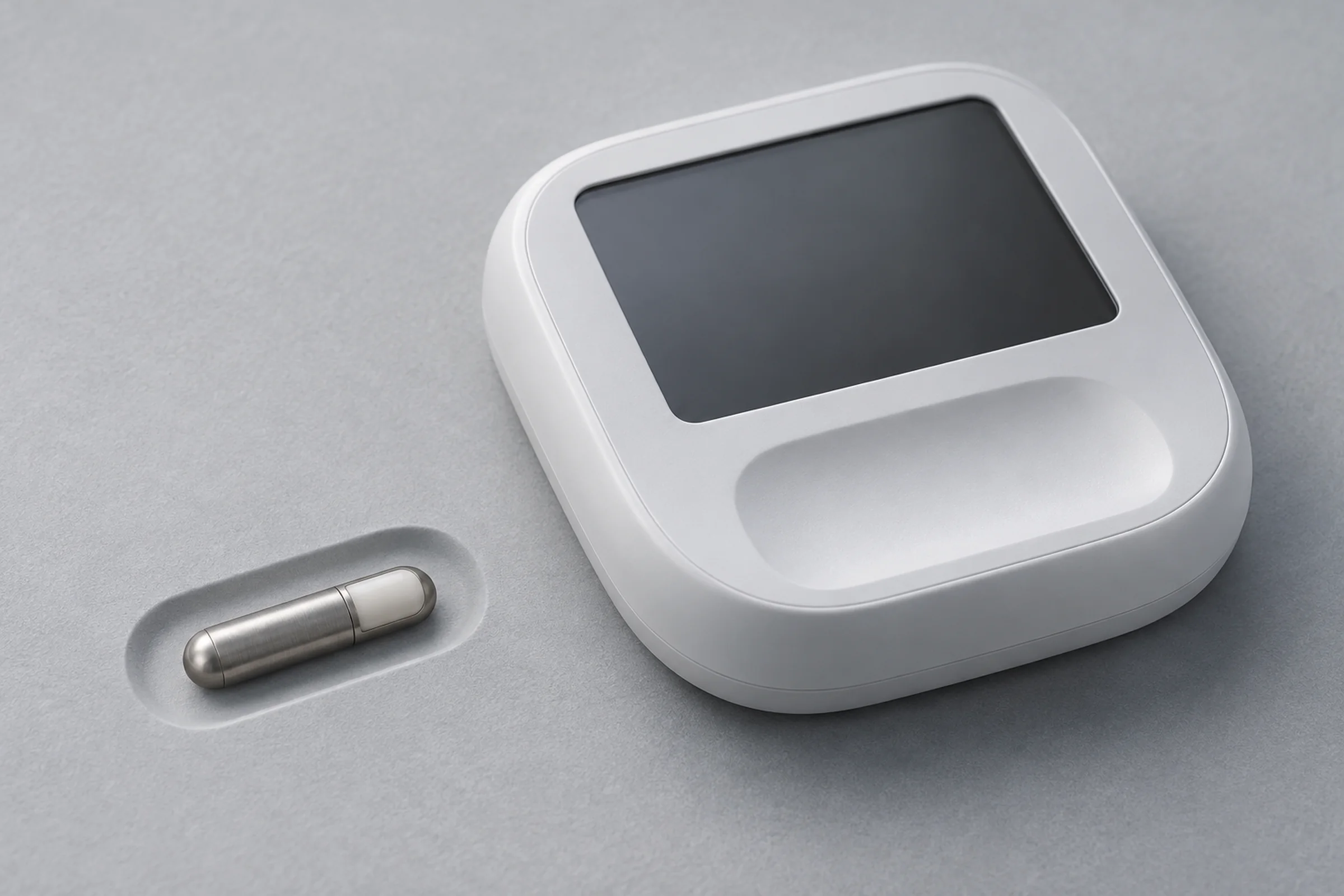
Illustrative sealed implant sensor beside a separate external reader dock
Representative visualization — not a photograph of a commercial product.

CURRENT APPLICATIONS

Four commercial pathways into the body

Established systems show how implantable electronics connect sensing, telemetry and external care workflows.

CARDIAC MONITORING

Permanent pressure monitoring

A small sensor placed in the pulmonary artery is read wirelessly by a compatible external system. The CardioMEMS HF pressure sensor is battery-free; its value lies in communicating measurements from inside the patient without an external sensor cable.

Abbott CardioMEMS patient FAQ

LEADLESS CARDIAC DEVICES

Communication between two implants

The AVEIR DR dual-chamber leadless pacing system pairs an atrial and ventricular device. Its implant-to-implant communication helps coordinate pacing, demonstrating a real architecture in which the wireless link is between implanted devices rather than only to a reader.

Abbott device overview

METABOLIC MONITORING

Long-duration implanted glucose sensing

Eversense 365 uses a sensor placed beneath the skin and a removable body-worn transmitter. The distinction matters: a system can have implanted sensing and wireless data exchange while retaining external wearable hardware.

Eversense 365 — official product information

SMART ORTHOPEDICS

Sensor-enabled orthopedic hardware

Persona IQ integrates motion-sensing technology into a knee-replacement stem extension and a connected monitoring ecosystem. It illustrates the emergence of implanted prosthetic hardware as a data source, beyond small standalone biosensor capsules.

Zimmer Biomet system overview

THE SYSTEM RELATIONSHIP

An implant is part of a connected system.

The functional architecture is determined by how power, data and action cross the boundary between the device and its environment.

IMPLANTED UNIT

Inside

A sensor, stimulator or controller designed to remain at its intended implanted location, with packaging and materials appropriate to that use.

WIRELESS INTERFACE

Across the boundary

Inductive, RF, acoustic, optical or other links perform specific power-transfer or communication functions; not every device uses every modality.

EXTERNAL EQUIPMENT

Outside

A reader, charger, smartphone-connected accessory, programmer or clinician-managed platform enables measurement, programming or use.

LIFECYCLE

In service

Reliable operation depends on software, workflows, verification, security, lifecycle support and device-specific approvals.
TECHNICAL DEPTH

Follow the hardware beneath the application.

From the first electrical coupling to long-life packages, each engineering chapter examines the design decisions behind real implantable systems.

POWER

Wireless energy

Charging and powering routes, alignment, penetration depth and received power.

Explore chapter →

DATA

Implant telemetry

RF interfaces, data integrity, coexistence and communication protocols.

Explore chapter →

MEASUREMENT

Biosensing

Physiological measurement, drift, calibration and reliable sensor reporting.

Explore chapter →

ASSURANCE

Verification

Biocompatibility, packaging, EMC, cybersecurity and clinical translation.

Explore chapter →

WIRELESSIMPLANTS.COM

Connected technology, from within.

Explore the underlying engineering or discuss the strategic acquisition of this domain.

Acquisition details