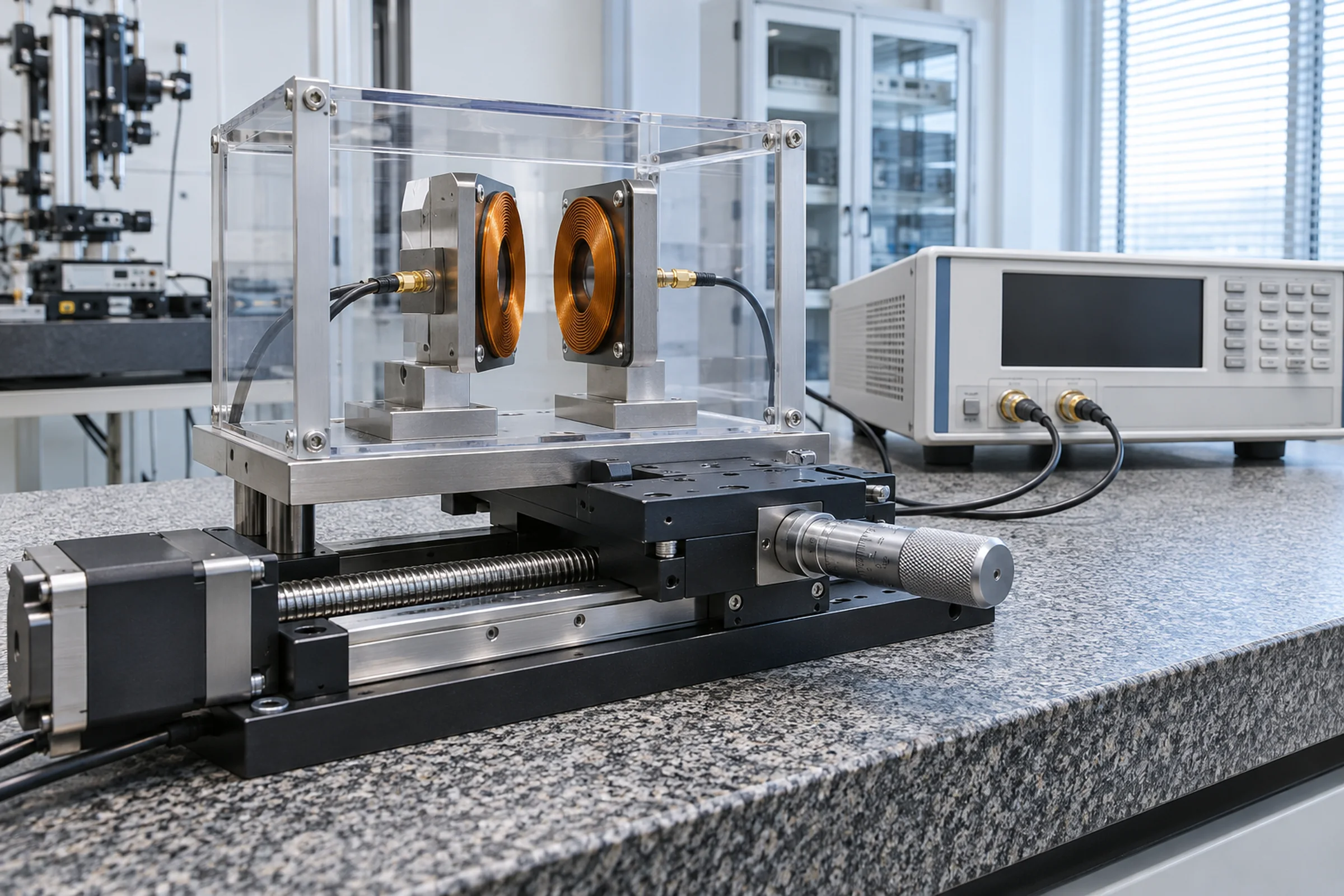
The transfer path
Near-field magnetic coupling transfers energy between an external transmitter and an internal receiver. Resonant circuits can improve useful transfer within a carefully engineered geometry, but efficiency changes with separation, orientation, adjacent metals and load. The design objective is sufficient, dependable received power under realistic anatomical and motion conditions—not a peak figure measured at one perfectly aligned position.
The implant-side budget
Rectification, regulation, sensing, microcontroller activity and radio transmission each consume energy. Energy storage may bridge short interruptions; battery-free does not necessarily mean buffer-free. Designers must account for transient startup, safe undervoltage recovery and losses across packaging materials.
Multi-node architectures
Research on magnetoelectric powering and networks demonstrates alternative ways to distribute energy to several small devices. Experimental performance depends heavily on the platform and measurement conditions. A distributed network also introduces coordination, interference and cumulative operating constraints that do not arise in a single receiver demonstration.
Translating the engineering
Useful verification includes alignment sweeps, implanted-depth phantoms, thermal analysis, duty-cycle testing and realistic external transmitter positioning. Variation-tolerant designs matter where skin movement or soft-device deformation changes the link. The strongest product opportunity pairs a credible charging arrangement with a defined clinical workflow, instead of treating wireless power as an isolated feature.
ENGINEERING CONSIDERATIONS
What robust development must address
- Transfer efficiency depends on distance and orientation
- Tissue heating and exposure limits must be addressed
- Power budget, packaging and patient behavior are inseparable
Practical development should connect measurable device requirements to a defined intended use and appropriate evidence. Research demonstrations and commercial medical-device claims must be assessed on their own terms.
PRIMARY SOURCES