Map the essential performance
Start with the device’s intended use, failure consequences, measurements, therapy parameters, external components and user workflow. Define which performance must be maintained in realistic environments and which safe states apply when a component is unavailable.
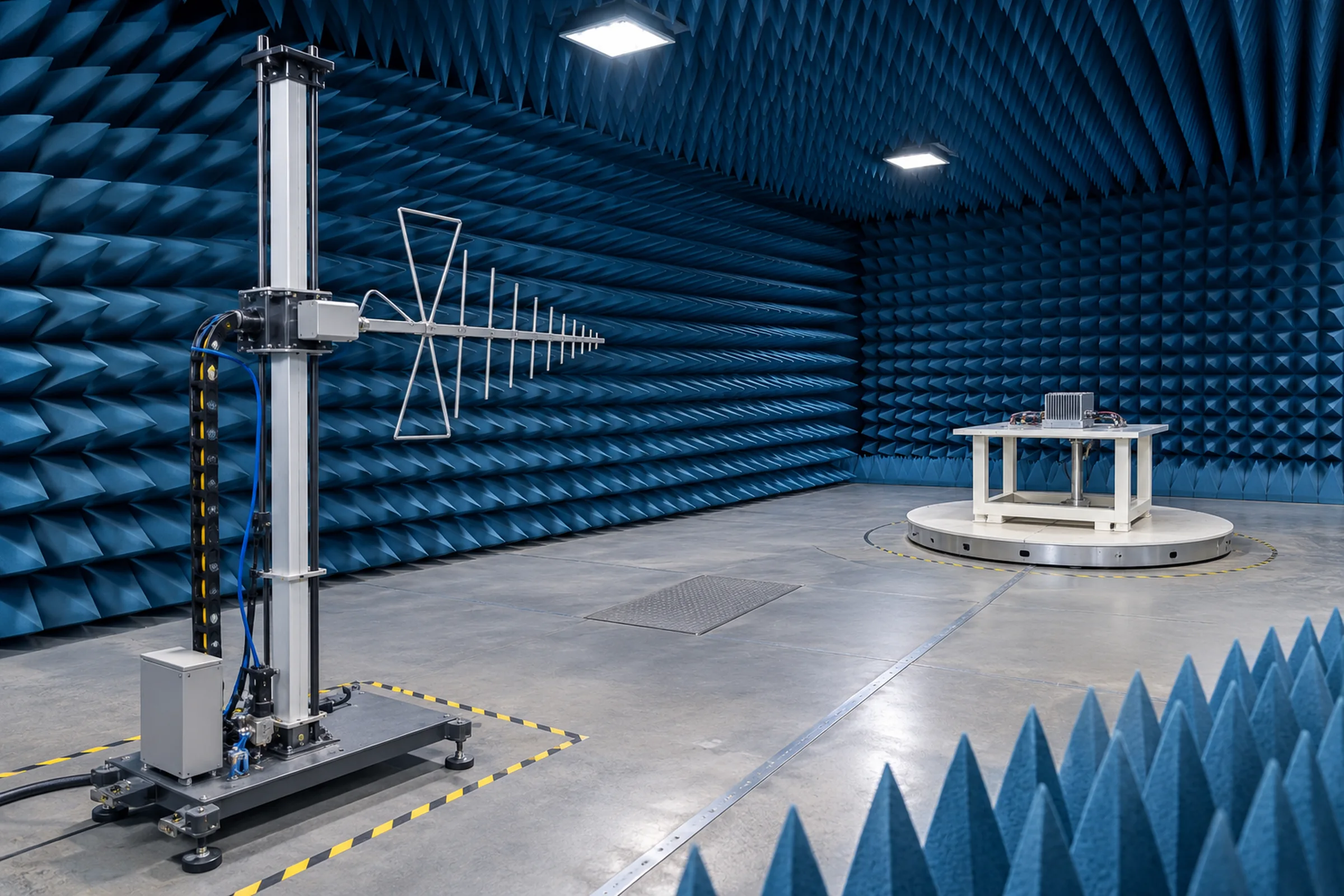
RF and electromagnetic testing
FDA wireless and EMC guidance addresses technology selection, quality of service, coexistence, electromagnetic compatibility and appropriate safeguards. A successful bench link is not a substitute for testing expected electromagnetic environments or concurrent wireless systems.
Biological and operational evidence
Contact duration, implant site, material selection, cleaning and sterilization, power exposure and thermal behavior all influence evaluation. For chronic operation, consider signal drift, mechanical wear, tissue response, degradation and foreseeable user behavior.
Security as part of safety
Connected devices need a lifecycle process for threat modeling, authentication, software updates, vulnerability response and external programmer controls. The risk is not only lost data; compromised or erroneous commands can affect functions that require high assurance.
European medical-device conformity and clinical evidence
For devices intended for the European Union market, Regulation (EU) 2017/745 (the Medical Device Regulation, or EU MDR) supplies a distinct regulatory framework. Depending on the device and its classification, requirements can include conformity assessment, a quality management system, risk management, clinical evaluation, technical documentation, appropriate notified-body involvement, CE marking and post-market surveillance. Wireless functionality adds system-specific considerations for electromagnetic compatibility, communications robustness, cybersecurity and long-term performance; the regulation does not automatically authorize any experimental implant.
The device’s intended purpose, risk classification, configuration and applicable transitional provisions determine the relevant assessment pathway. Read the consolidated EU MDR regulation.
ENGINEERING CONSIDERATIONS
What robust development must address
- Device claims must match the validated use case
- Coexistence, EMC, bioevaluation and cybersecurity form one safety case
- Research results are not equivalent to regulatory authorization
Practical development should connect measurable device requirements to a defined intended use and appropriate evidence. Research demonstrations and commercial medical-device claims must be assessed on their own terms.
PRIMARY SOURCES