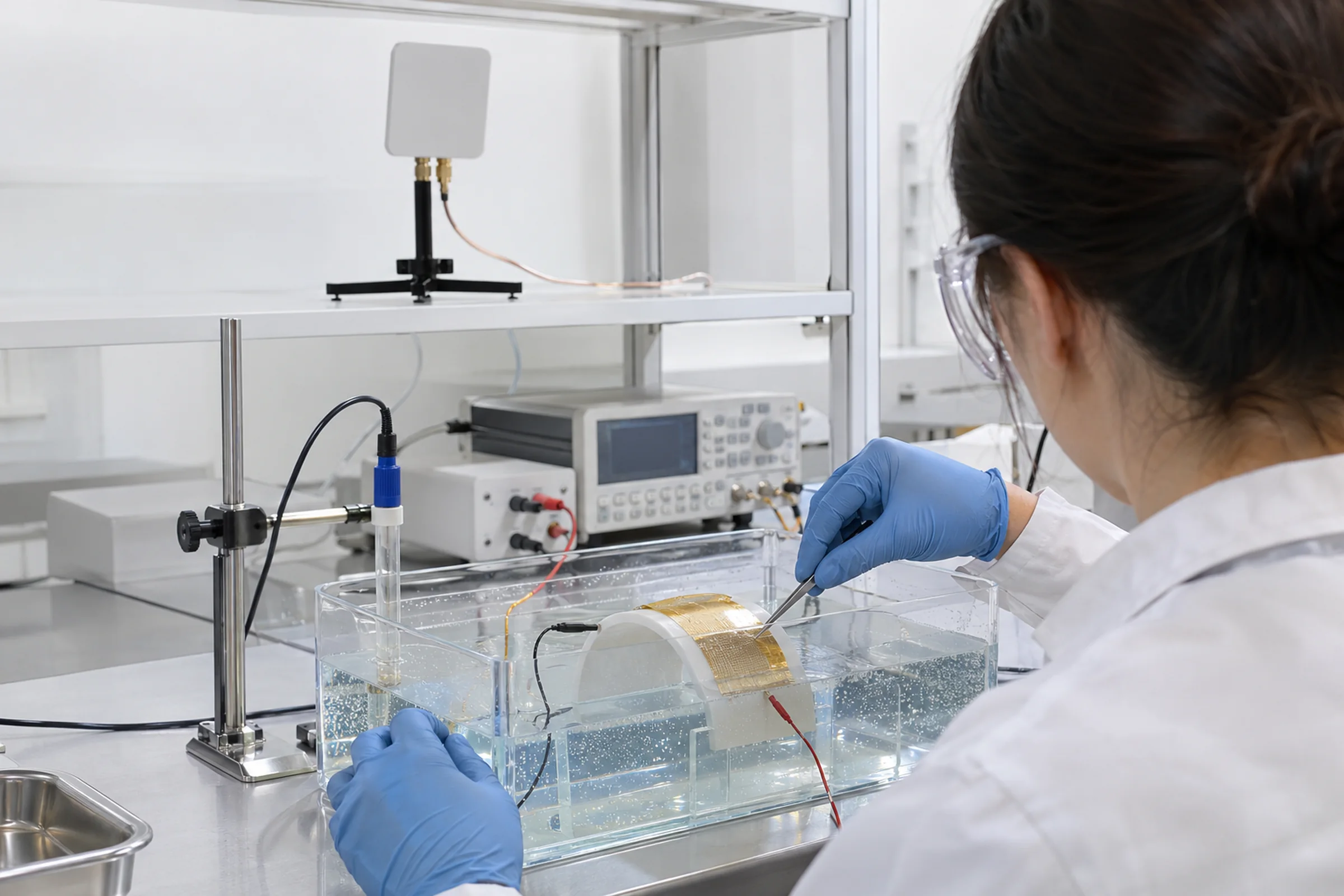
Signal fidelity begins at the interface
Neural signals can be small and susceptible to motion, electrode impedance and circuit noise. A well-engineered interface considers electrode geometry, mechanical compliance, signal-chain noise, digitization accuracy and long-term response at the biointerface.
Wireless means systems-level constraints
Wireless powering and data telemetry must share tight thermal and energy budgets with amplifiers, ADCs, processors and any stimulation drivers. Heat, size, latency, transmission duty cycle and power availability constrain how many channels are practically useful.
Research milestones and their scope
A 2025 Nature Electronics paper reported a flexible, subdural-contained system with a 65,536-electrode array and 1,024 channels alongside integrated processing, telemetry and wireless powering. The publication documents a research architecture; it does not imply identical clinical performance or adoption across BCI systems.
The route to a clinical system
Biosafety, chronic tissue response, secure external programming, recording performance and system failure modes must be evaluated for the intended population. Hardware that performs well in laboratory characterization still needs validation in the relevant clinical context.
ENGINEERING CONSIDERATIONS
What robust development must address
- Signal quality and wireless power compete within the thermal budget
- Electrode/tissue interfaces evolve over time
- Clinical outcomes cannot be inferred from channel counts
Practical development should connect measurable device requirements to a defined intended use and appropriate evidence. Research demonstrations and commercial medical-device claims must be assessed on their own terms.
PRIMARY SOURCES