WirelessImplants.com is available for strategic acquisition Enquire discreetly

HUMAN–MACHINE INTERFACES · PROSTHETICS

Where implanted signals meet robotic motion.

Implanted sensors and interfaces can connect internal biological activity with external prosthetic systems. They turn otherwise inaccessible movement or neural information into signals an engineered controller can use.

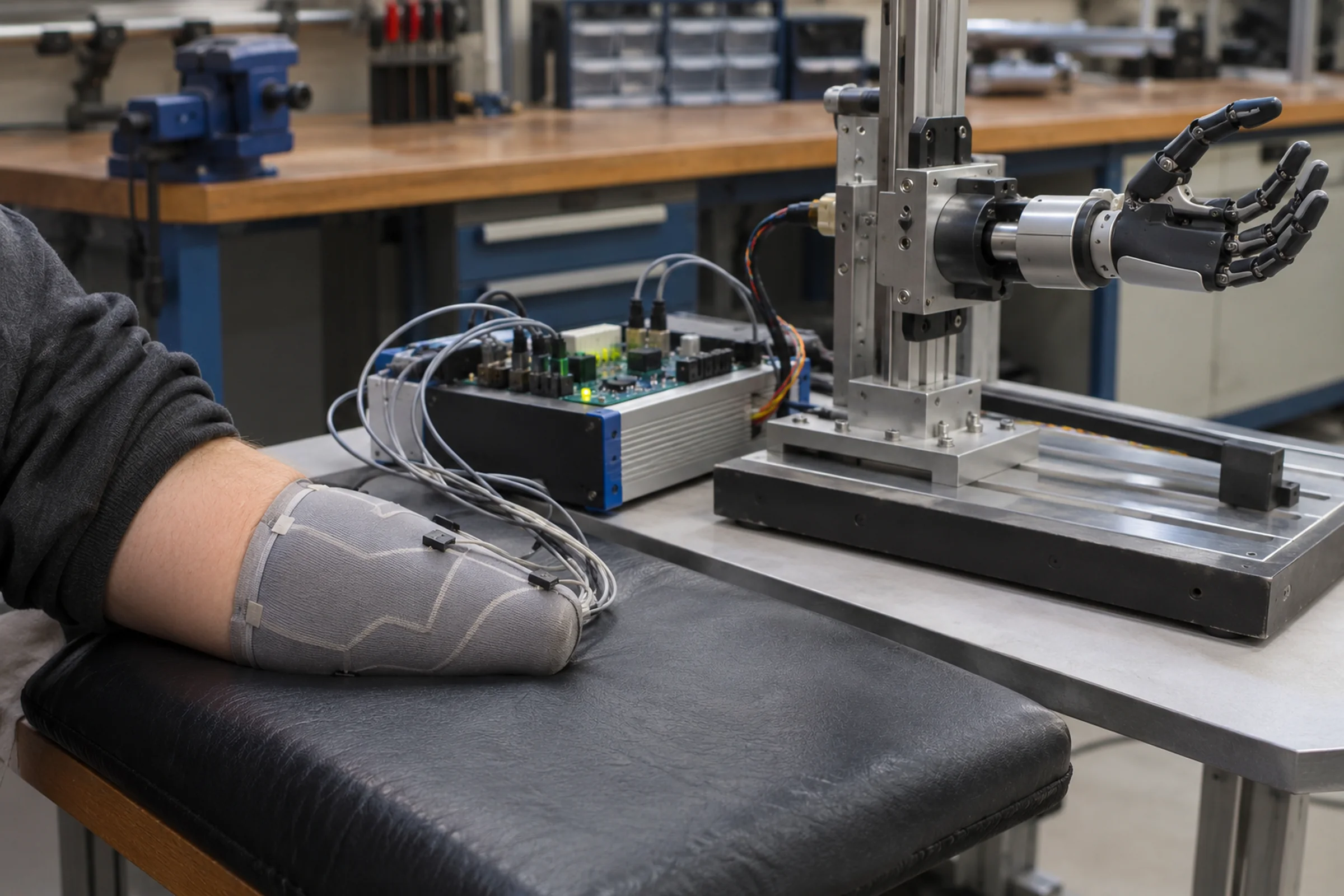
Residual-limb sensor sleeve and bench-mounted prosthetic research controller
Representative visualization — not a photograph of a commercial product.

MUSCLE-BASED INTERFACES

From muscle dynamics to external control.

The implant and the robotic device occupy different sides of the body boundary, linked by sensing and signal processing.

2026 HUMAN RESEARCH

Passive magnetic muscle implants

MIT researchers reported human testing of paired magnetic markers implanted into residual-limb muscles. External sensors track the markers wirelessly to infer muscle motion; a three-participant evaluation investigated control signals for a virtual prosthetic task. This is a studied interface, not an approved general-purpose robotic control product.

MIT research report

2025 RESEARCH

Wirelessly connected peripheral interfaces

A published first-in-human technical report examined an implanted system combining myoelectric sensing, nerve stimulation and wireless communication for advanced prosthetic control. Such research links implanted sensing hardware with an external prosthesis, its controller and user feedback.

Peer-reviewed technical study

ANATOMY TO ACTUATION

Four coordinated functions.

The value is in the full path between a signal inside the body and the action outside it.

SENSE

Implanted interface

Markers, electrodes or sensors capture a biological variable with suitable placement and stability.

CONNECT

Wireless interrogation

External sensors or wireless electronics recover the implanted signal without a permanent transcutaneous signal cable.

INTERPRET

Decoding and control

Calibration, filtering and control algorithms translate measurements into useful commands.

ACT

External actuation

A prosthetic limb, rehabilitation system or robotic interface performs controlled motion.

ENGINEERING DISCIPLINES

A credible pathway from sensing to movement.

Stable interfaces require more than raw signal quality: they involve physiological movement, packaging, electromagnetic behavior, calibration and user adaptation.

BIOINTERFACE

Long-term interface stability

Electrode placement, signal drift, movement artifacts and material response shape the life of an implanted sensing interface. Passive magnetic-marker systems offer a different sensing mechanism from active bioelectronic implants and require different evaluation methods.

Magnetic sensing research

SYSTEM ARCHITECTURE

Robotics is the destination, not necessarily the implant

The biological interface may be implanted while motors, actuators, control software and the prosthesis are external. This distinction connects implant technology to robotics without relabeling every embedded robotic sensor as an implant.

Implanted prosthetic interface study

RELATED ENGINEERING

Explore the technologies behind human–machine connectivity.

Wireless interfaces sit at the junction of miniature electronics, sensing, communication and validation.

WIRELESSIMPLANTS.COM

Connected technology, from within.

Explore the underlying engineering or discuss the strategic acquisition of this domain.

Acquisition details